
The EU is introducing a Digital Product Passport scheme for certain products to improve sustainability, circularity, and legal compliance. From February 2027, certain classes of battery will need a battery passport before they can be sold in the EU. Susanna Jankovic explains how the scheme will work and what manufacturers need to do to prepare.
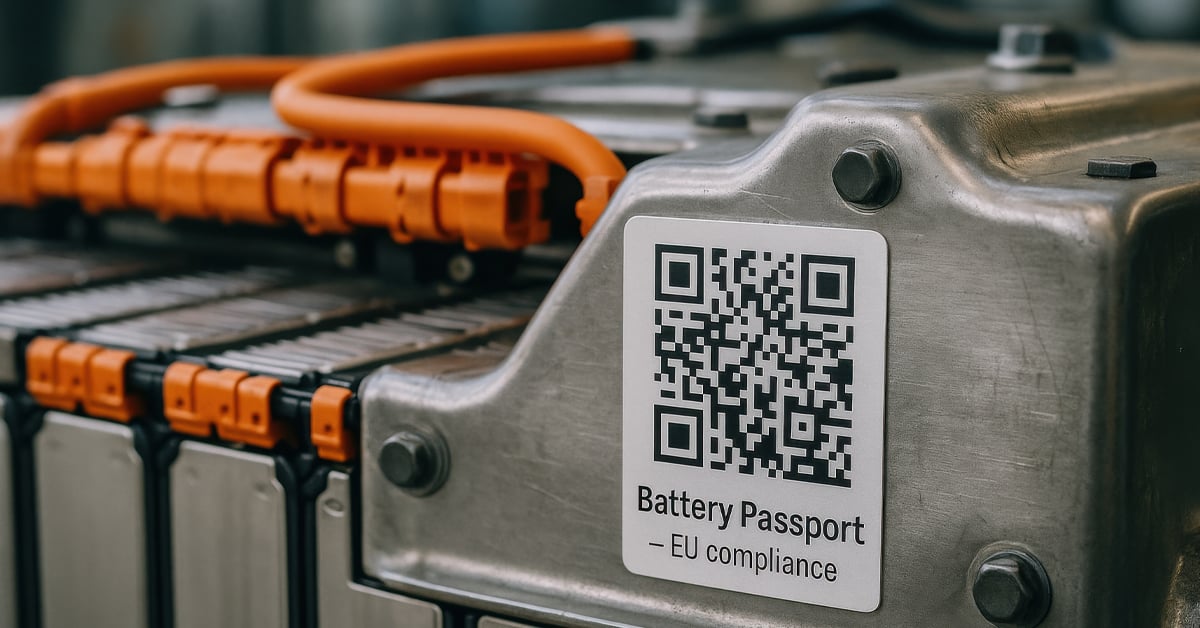


At a glance
- The Digital Product Passport (DPP) stores information about a product’s composition, sustainability, lifecycle, and compliance.
- The DPP is a digital, machine-readable record.
- Each DPP is registered in the EU’s DPP registry and can be accessed via a data carrier, such as a QR code, on the product.
- Industrial software will play a key role in supplying DPP data, especially composition, durability, recyclability, maintenance, and end of life information.
- Aligned to key objectives of the UN SDGs, the goal is to improve sustainability, circularity, and legal compliance.
- A DPP will be mandatory for certain classes of battery from February 18, 2027. Without one, they cannot be sold in the EU.
What is a digital product passport? And how will it affect your products?
Digital product passports will soon be introduced across the EU for certain categories of product, starting with batteries in February 2027. They are designed to make reliable product information available to businesses, consumers, repairers, recyclers, and customs and market surveillance authorities.
The Ecodesign for Sustainable Products Regulation (EU) 2024/1781 (ESPR) creates a broad EU-wide framework that allows sustainability, circularity, and transparency requirements, including durability, reparability, and energy efficiency, to be set for almost all physical goods. These requirements become binding product group by product group through delegated acts. The ESPR contributes to three important UN sustainable development goals (SDGs): Goal 12: to ensureresponsible consumption and production; Goal 9: to build resilient industry, innovation, and infrastructure; and Goal 13: to take climate action and reduce carbon emissions in line with the Paris Agreement.
Think of the DPP as a bit like a birth certificate plus service record: it accompanies a product throughout its life.
What falls into scope of the battery passport?
The first products to be impacted by the introduction of DPPs are batteries. Three types of batteries fall into scope: electric vehicle (EV) batteries; light means of transport (LMT) batteries, such as those in e-scooters and e-bikes; and industrial batteries with a capacity greater than 2kWh.
From February 18, 2027, these batteries need a battery passport when they are placed on the EU market. Batteries placed on the market before this date do not need one retroactively.
The battery passport applies to the finished battery. It may contain multiple cells or packs. For a traction battery, the finished battery would normally include the battery management system (BMS) and any other components required to ensure safe operation.
The responsibility for creating the DPP lies with the entity bringing the battery to the EU market. This is typically the manufacturer or the importer, meaning whoever is the economic operator responsible for bringing the goods to market. For example, when the battery is supplied as part of a vehicle without additional battery components or systems being required in the vehicle manufacture, the battery manufacturer is responsible for the battery passport. However, if the vehicle manufacturer completes the battery, for example with the addition of a BMS or other essential components, the party responsible would be the vehicle manufacturer. In both cases, the battery passport stays with the battery, not the larger machine.
The battery passport relies on the common DPP technical system established under the ESPR, but its legal basis and content are defined in a separate piece of legislation: the Battery Regulation. Guidance from the Commission structures the battery passport requirements into 71 data points (as of October 2026).
Collating battery passport data begins on the shopfloor
These data points do not all come into play at once. Identification, composition, performance, and safety data is required from day one. Usage data must be added as soon as the battery is in use, while carbon footprint, recycled content, and due diligence information will follow later.
Most of the battery passport must therefore be filled in from the start. For EV batteries, more than 40 of these data points are mandatory from day one, with slightly different sets for LMT and industrial batteries. These include identification data, such as the unique identifier, manufacturer details, model, batch or serial number, production date and location, weight, capacity, and chemistry. They also cover materials and composition, hazardous substances, renewable content share, performance and technical specifications, and compliance and safety information. In addition, the passport contains restricted data such as dismantling instructions and test reports.
It’s crucial, therefore, that shopfloor systems are incorporated into DPP planning. This also applies if a manufacturer does not place its batteries on the EU market itself but supplies them to an importer or a vehicle manufacturer, for example. The responsible company needs the production data for the battery passport and will usually require it contractually.
This data may be spread across multiple systems, from shopfloor machines to lab systems and MES/ ERP software. Bringing this data together with a common product context will be critical.
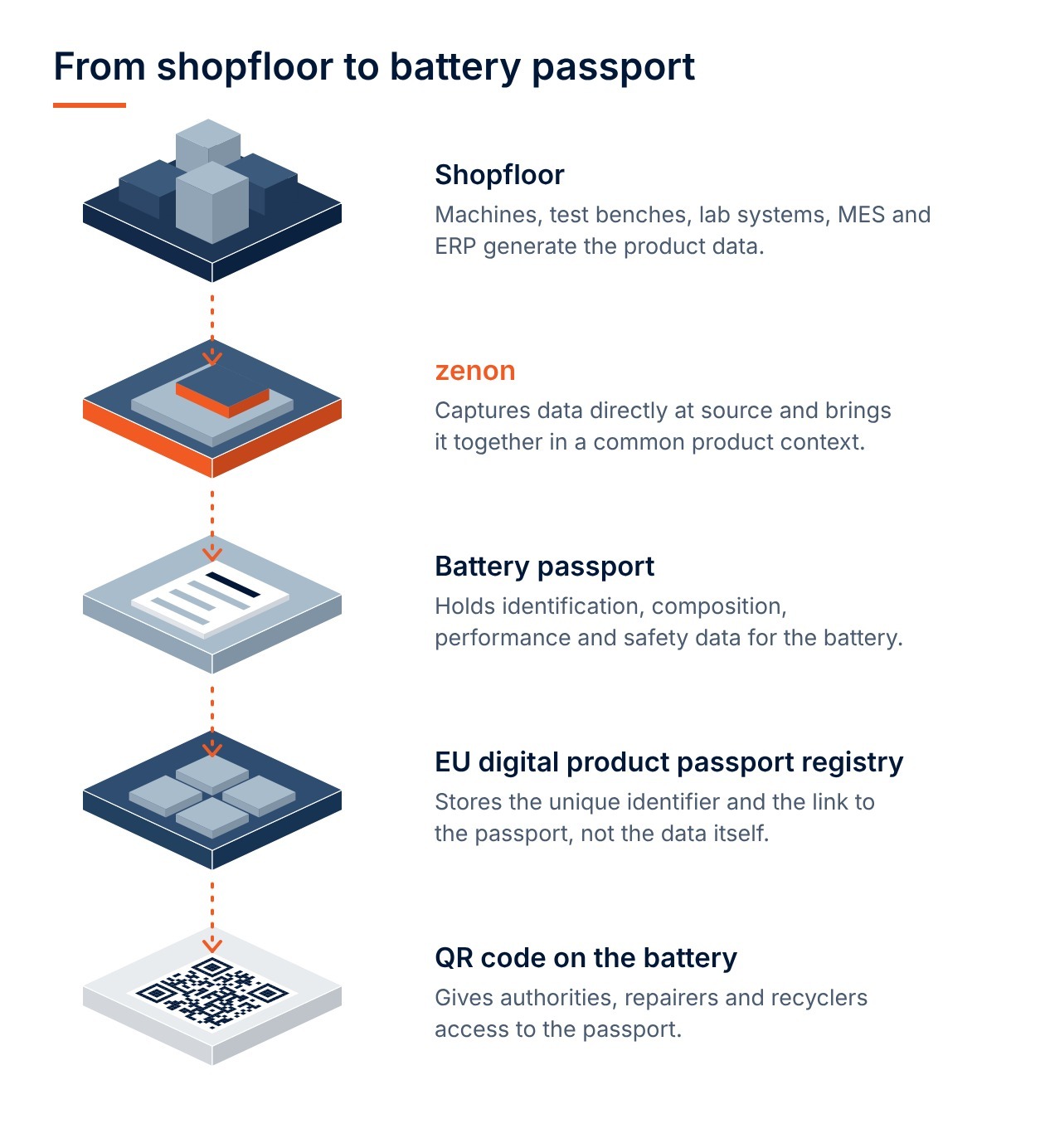
Data flow from the shopfloor via zenon to the battery passport, the EU registry and the QR code on the battery.
The battery passport: A blueprint for every product to follow
The ESPR specifies that all DPPs should be registered in the EU’s DPP Registry. The DPP Registry acts as an index service for all DPPs of products placed on the EU market. It does not contain the full, detailed product information, which is stored in the DPP itself. Rather, the registry is a secure database that stores the unique identifiers, registration data and high-level metadata for each product together with a link to the relevant DPP.
The DPP Registry went live on July 20, 2026, under Commission Implementing Regulation (EU) 2026/1778. Economic operators must first register with the service and be verified. They can then register products, with batteries as the first product group. To facilitate this, the registry supports an API as well as manual data import.
A set of harmonized European standards underpins the interoperability of the DPP system. The first six, covering unique identifiers, interoperability, data carriers, APIs, data exchange protocols, and data storage, were published by CEN and CENELEC and cited in the Official Journal of the EU in July 2026 (Commission Implementing Decision (EU) 2026/1736).
A DPP must be completed for each registered product and stored in a compliant way. As well as linking from the registry, the link to the DPP must be included with the product itself. In the case of batteries, this must be actioned via a QR code on the product. The QR code (data carrier) must be open, interoperable, machine readable, durable, lead to an accessible and functional DPP, and placed in a visible location.
The ESPR legislation makes provision for the data carrier or machine-readable link to the DPP from the product to be realized in different ways depending on product group. For other product groups it may be a linear barcode symbol or two-dimensional symbol rather than the QR code required for batteries. More details will be given as detailed product group legislation and guidance is published. The first ESPR Working Plan (2025 to 2030) names the following priority product groups, with indicative dates for the adoption of the delegated acts: iron and steel (2026); textiles, aluminum, and tires (2027); furniture (2028); and mattresses (2029). In addition, horizontal measures on repairability scoring and on recycled content and recyclability of electrical and electronic equipment are planned. The requirements usually apply at least 18 months after a delegated act is adopted.
From product to circularity: Tracking the lifecycle of an in-scope battery product
The data that follows later will be added step by step: the carbon footprint declaration and label once the relevant implementing acts are in place, the recycled content data in line with Article 8 of the Batteries Regulation, and the public due diligence report from August 18, 2027. Some details may still change, as the Batteries Regulation is currently being amended through an EU simplification (omnibus) package, but the start date of the battery passport is not affected.
The battery passport will also include dynamic data which must be updated when a change in the battery’s status occurs, for example when deciding whether to remanufacture, repurpose or recycle it. More frequent updating may be necessary for certain dynamic data if technically feasible and proportionate, for example for state of health data if the battery has a BMS or when an offline battery is brought in for servicing.
A new battery passport is required when a battery is repurposed or remanufactured or after it has become waste and then prepared for reuse or repurposing. Normally, a new economic operator would assume responsibility at this stage.
Given this lifecycle commitment, manufacturers and economic operators need to put in place the relevant data capture and data sharing capabilities to ensure the DPP is complete and up to date throughout the battery’s lifecycle.
The battery passport: From compliance to competitive advantage
It’s clear from the type of detailed technical information included in the battery passport that the DPP will make the professional repair, refurbishment, and high-quality recycling of in-scope batteries easier and more cost effective. The Commission hopes that it will create new commercial opportunities in this area.
Companies will be able to track materials across the supply chain to enhance transparency from production to end of life. It is intended that this will help businesses to identify opportunities to improve resource efficiency and reduce environmental impact.
The DPP will also make it easier for businesses to interact with market and customs authorities via the standardized sharing of data. The goal here is to aid the relevant market authorities and customs as well as making compliance operations more efficient for businesses.
Forward-thinking manufacturers and other economic operators can use the verifiable information in the DPP about their product’s durability, repairability, and environmental impact to stand out from their competitors. In particular, the EU hopes that the DPP presents an opportunity for SMEs to demonstrate transparency about sustainability and quality that can lead to competitive advantage, new market opportunities, and stronger relationships with customers who value these aspects. The table below shows how battery passport data supports the UN SDGs across the lifecycle of a battery.
|
Lifecycle stage data |
SDG contribution |
|
Sourcing |
SDG 8, SDG 12 |
|
Production |
SDG 9, SDG 13 |
|
Use and second life |
SDG 7, SDG 12 |
|
Recycling |
SDG 12, SDG 13 |
There are shopfloor benefits for manufacturers too. The data which must be collected to create the DPP has wider potential for use. For example, details of energy transparency per product can inform shopfloor energy optimization initiatives. Similarly, the improved traceability could enable faster root-cause analysis and narrower recalls and, ultimately, less scrap. Furthermore, manufacturers have an opportunity to create a single data foundation for DPP, CSRD, and CSDDD reporting.
zenon offers an ideal basis for such a single data foundation. In many cases, the required information is already available in zenon and its proven IT/OT connectivity provides an important bridge between that shopfloor data and the digital passport.
The battery passport: Actions to take now
The DPP changes how companies capture, connect, and share product data. Without a valid battery passport, a battery cannot be placed on the EU market from February 18, 2027. Authorities can order withdrawals or recalls, and member states set their own fines. Manufacturers and economic operators impacted by the battery passport should therefore start now, to be ready for the battery passport and every DPP that follows.
The work begins with clarifying responsibilities and agreeing or amending supplier / seller contracts early. Identify the economic operator that brings your product to the EU market and ensure that they are registered and verified with the DPP registry.
Manufacturers must establish the right cross-functional teams who can put in place the necessary data architecture. Capture data at source, connect OT with IT, build on open standards in accordance with the specified data standards, and ensure data can be shared securely as necessary.
Take the time to turn this new responsibility into an opportunity, and act on your own terms rather than under pressure.