
From legacy to agility: virtualization is key to future-proof operations


For years, legacy systems have done exactly what they were built to do: run reliably, predictably and with minimal disruption. However, the world around these systems has changed with an increasing move towards real-time data exchange.
Industrial control systems, supervisory control and data acquisition (SCADA) platforms and operational technology (OT) environments were never designed for such high volumes of real-time data, cloud connectivity or today’s volatile energy markets. Many of these systems are still running after 15, 20, even 30 years. As the world changes, the longevity of these systems is becoming part of the problem.
According to Deloitte, more than 70 per cent of global energy infrastructure is now more than 25 years old. This is not just a statistic; it’s a signal that a large part of the industry is running on systems that were designed long before cloud connectivity, high-frequency data exchange and real-time grid balancing became standard requirements.
As a result, many of these systems are now reaching the limits of what they can reliably support. Typical challenges include hardware obsolescence as manufacturers discontinue support and spare parts, operating systems that no longer receive security updates, limited scalability that requires costly hardware expansion, and proprietary protocols that complicate integration with modern IT systems and cloud platforms. At the same time, unpatched legacy environments increase exposure to evolving cyber threats. Nowhere are these issues more apparent than in renewable energy.
This growing pressure is also reflected in the market: the global OT sector is expected to expand significantly in the coming years, underlining how urgently organizations need to modernize existing infrastructure rather than simply maintain it.
When volatility becomes the new normal
Wind and solar don’t behave like traditional generation. Renewable outputs change constantly, yet grid operators still expect instant responses to these fluctuations. Systems that can’t keep up with this volatility can slow processes down and also introduce risk. At the same time, operators are required to maintain grid stability at all times, making responsiveness not just a technical requirement but a regulatory obligation.
As highlighted by Microgrid Knowledge, modern renewable plants increasingly rely on SCADA systems capable of autonomous or near real-time dispatch, underscoring how critical responsive control infrastructure has become in maintaining grid stability.
Why replacing everything is no longer the answer
Previously, and in response to challenges like these, modernized legacy infrastructure used to mean one thing: replace everything. This is expensive, disruptive and often unrealistic, but increasingly also a thing of the past thanks to virtualization. Through virtualization, it’s instead possible to create a virtual, software-based version of something instead of relying on physical systems like computers, servers, storage or networks.
Instead of tying software to a specific piece of hardware, virtualization separates the two. Applications can run inside virtual machines, which can be moved, copied, or restored without affecting operations. This separation of software and hardware also enables key capabilities such as system snapshots and rollback, allowing environments to be restored instantly in case of failure, as well as isolation between applications so that issues in one system do not affect others.
Furthermore, legacy PLC and SCADA environments can be virtualized while maintaining deterministic behaviour and real-time performance requirements. The advantage here is that managers and operators can keep what works, and upgrade what doesn’t. And they can do it without shutting everything down.
Keeping what works without holding back progress
Virtualization can bring real value. For instance, one of the biggest barriers to modernization is fear of change; or, more specifically, fear of incompatibility. What happens to that one critical legacy system that no one wants to touch? The old essential system that still works, but no one fully understands anymore?
Virtualization provides a safety net in these instances. Within a virtual system, legacy operating systems can run inside isolated environments and old interfaces can be emulated. Established protocols can be connected to modern systems without the need to rewrite everything from scratch. This also includes the ability to replicate legacy-specific interfaces and support older operating systems as secure guest environments, ensuring compatibility without compromising stability or compliance. Where engineers had to previously choose between stability and progress, they can now have both.
When scale and speed start to break old systems
Protecting legacy systems through virtualization is one example of mitigating risk. Any changes to hardware, software and security patches invite risk in traditional industrial setups, and must be prepared for carefully, cautiously and often reluctantly.
And there are changing external factors, which are happening faster and with far less margin for error. Take renewables, for instance, which are scaling rapidly.
According to the International Renewable Energy Agency (IRENA), global renewable capacity reached more than 5,100 gigawatts (GW) in 2025, accounting for nearly half of total installed power capacity. This growth is both a global success story and a source of increasing complexity as more and more renewables assets are being connected. More data is being generated. And variability has become a defining characteristic of the system, rather than an exception.
Control infrastructure is under pressure as a result. Systems must respond in real time, process far higher volumes of data and do so without compromising stability or reliability. The problem? Many legacy environments were simply not designed for that level of demand.
Microgrid Knowledge reports that a traditional combined cycle power plant typically generates around 25 data points per megawatt (MW), whereas solar installations generate between 200 and 500 data points per MW and battery storage systems can produce up to 1,500 data points per MW. In practical terms, a 750 MW battery site may generate close to one million individual data points. This is far beyond what human operators can analyse manually.
Virtualization helps close that gap. It allows operators to integrate forecasting tools, process grid signals more efficiently and manage distributed assets within a unified environment. This provides the flexibility needed to operate effectively in a system that is constantly changing. It also enables multiple control functions to run in parallel, such as balancing grid frequency while simultaneously optimizing market participation strategies.
Even a network interruption of less than 10 milliseconds can disrupt communication between controllers and field devices, potentially leading to system-wide failures if not properly managed.
Moreover, virtualization supports predictive and preventative maintenance strategies. Instead of reacting to problems, teams can anticipate them. Systems can be duplicated, tested, or rolled back if needed. Updates can be validated before they ever reach production, and capacity can be adjusted without waiting for new hardware to arrive. This structured approach also supports lifecycle management, allowing systems to be migrated to new hardware without changing the operating system, patches to be tested in isolated environments, and capacity to be scaled through software rather than physical expansion. As a result, what once caused disruption becomes part of normal operations.
Modernization works best when it’s done step by step
It’s fair to say that industry hesitates to embrace virtualization because of the misconception that virtualization must be implemented all at once, which makes it seem risky and disruptive. The reality is that virtualization should not be implemented all at once. It should, in fact, be introduced gradually, which also reduces risk and spreads costs.
However, organizations are also rightly concerned about the incremental rollout of virtualization. It can create complex hybrid environments where physical and virtual systems must operate together. This makes management, integration and security more difficult; it can lead to inconsistent processes, duplicated workloads and increased training demands for staff who must handle multiple systems at once.
Organizations should start small by beginning with a single system or application, then expand step by step. This phased approach reduces operational risk and allows teams to build confidence as they go. However, this also requires a shift in how teams work together. IT and OT have traditionally operated in parallel, but virtualization brings those domains closer together. Aligning priorities, processes and expertise becomes essential for success. In this context, a vendor-neutral approach also plays a key role, helping organizations avoid creating new dependencies while retaining flexibility when selecting technologies and partners.
Security can’t be an afterthought
Security plays a central role as well. It cannot be treated as a secondary consideration. Standards like the ISA / IEC 62443 framework highlight just how critical it is to design cybersecurity into systems from the beginning, rather than adding it later.
As published by the International Society of Automation, the ISA/IEC 62443 series defines cybersecurity requirements across the full lifecycle of industrial automation systems, from initial design and risk assessment through to ongoing operation and maintenance. This makes it one of the most comprehensive frameworks for securing modern, virtualized OT environments. Industry analysis from IoT Analytics highlights that this shift is accompanied by rapid IT/OT convergence and the adoption of software-defined architectures, where virtualization plays a key role in enabling scalable, secure and segmented industrial environments.
When these elements come together, virtualization delivers more than efficiency gains. It strengthens the overall resilience of entire industrial operations.
From infrastructure to operational intelligence
Virtualization is not a purely technical topic; it’s also a question of how systems are managed and decisions are made. For instance, reduced dependency on hardware makes it easier to adapt systems over time. Testing, updating and scaling become more controlled processes rather than disruptive events.
This shift toward software-defined control environments is also reflected in industry practice, where integrated platforms increasingly combine SCADA, analytics and asset management into unified systems capable of managing distributed renewable assets efficiently.
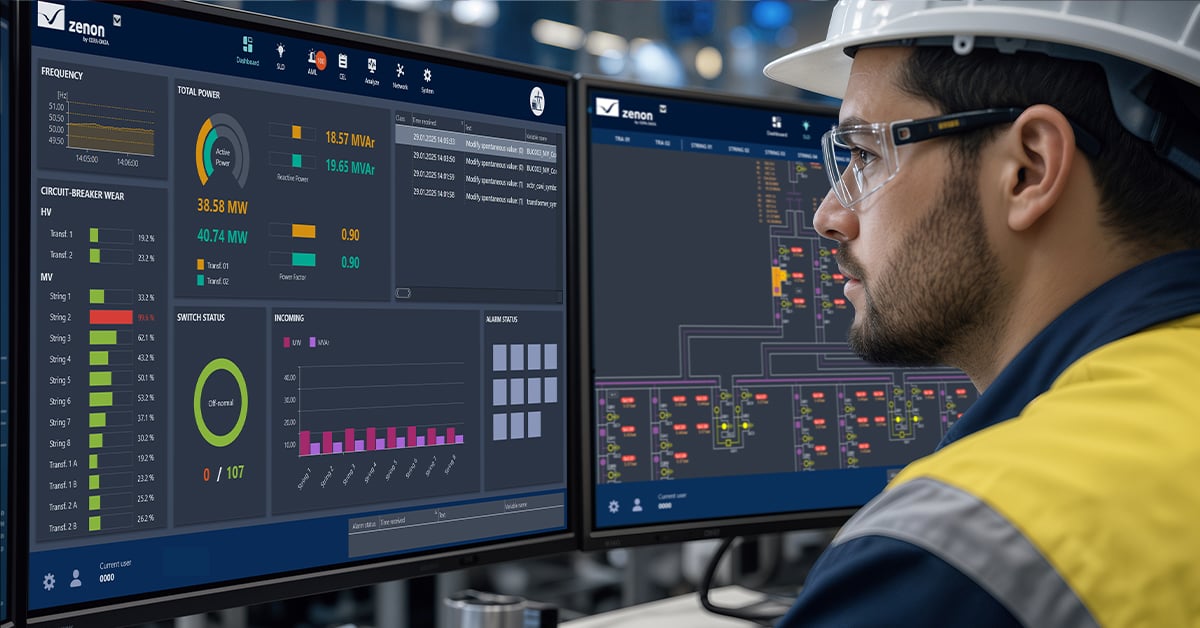
To support this level of integration and operational transparency, organizations increasingly rely on software platforms that can connect legacy and modern systems, centralize data and provide consistent visibility across operations. As a hardware-independent software platform, zenon enables the integration of both legacy and modern systems within a unified environment. It supports real-time monitoring, centralized control and consistent data access across operations. This combination is what allows virtualization to move beyond infrastructure. It becomes part of a broader operational system, where data flows more freely, decisions are better informed and complexity is easier to manage.
Instead of the large-scale replacement projects of previous decades, virtualization allows systems to evolve gradually, without interrupting ongoing operations. It creates a foundation that is better suited to future requirements. For organizations that take this approach, the benefits extend beyond technology. They gain greater flexibility, improved resilience and a clearer path to adapting as conditions continue to change.